
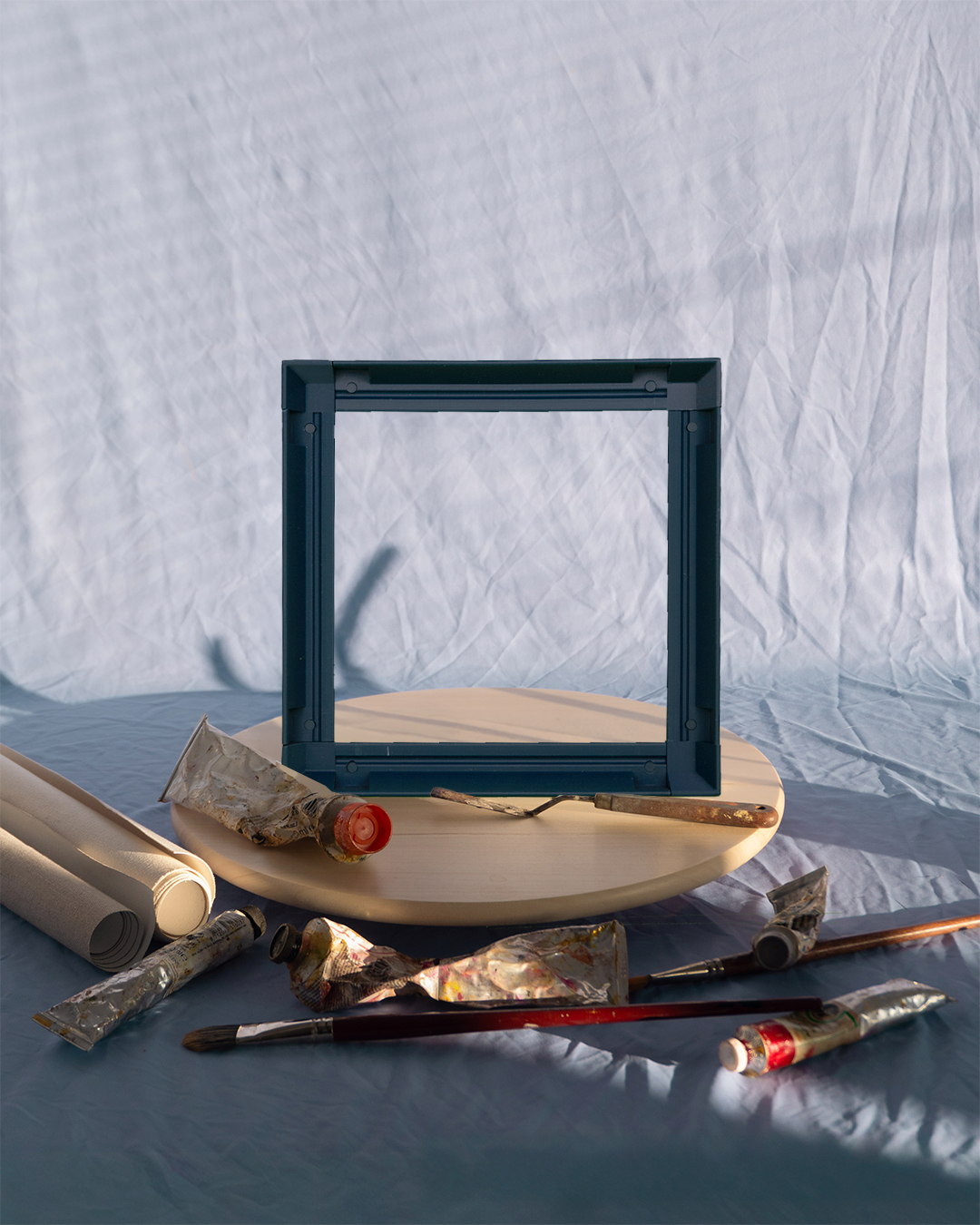
Why haven’t art tools evolved in decades?
The stretcher canvas frame—arguably one of the most essential tools in painting—has remained fundamentally unchanged for centuries.
Since the early development of oil painting on canvas in the 15th century, artists have relied on a wooden stretcher frame to tension and support the canvas surface. Over time, the system was refined in terms of joinery, tensioning keys, and standard sizing, but the core principle has stayed exactly the same: a fixed wooden structure that holds fabric under tension.
Today, whether in traditional studios or contemporary art practices, the same logic still applies. A rectangular wooden frame, cross bracing for stability, and mechanical tensioning through wedges or keys. Materials may vary slightly—pine, hardwoods, engineered wood—but the system itself has barely evolved in its essence.
This raises an important question: why has one of the most fundamental tools in art remained almost untouched since the 15th century?
At Formaet®, we started from this question.
We are building the first meaningful evolution of the stretcher canvas system in centuries: a patented modular system designed specifically for artists’ real creative workflows. Not an iteration of the old model, but a complete rethinking of how canvas structures can adapt, expand, and evolve over time.
Our system replaces rigidity with modularity. Fixed dimensions with scalability. Waste with circular design.
Made from ocean-bound recycled plastic, Formaet® is designed to respond to the needs of contemporary artists: flexibility, sustainability, and creative freedom without constraints.
This is not just a product innovation. It is a shift in how we understand the infrastructure of art itself.
Leave a Reply